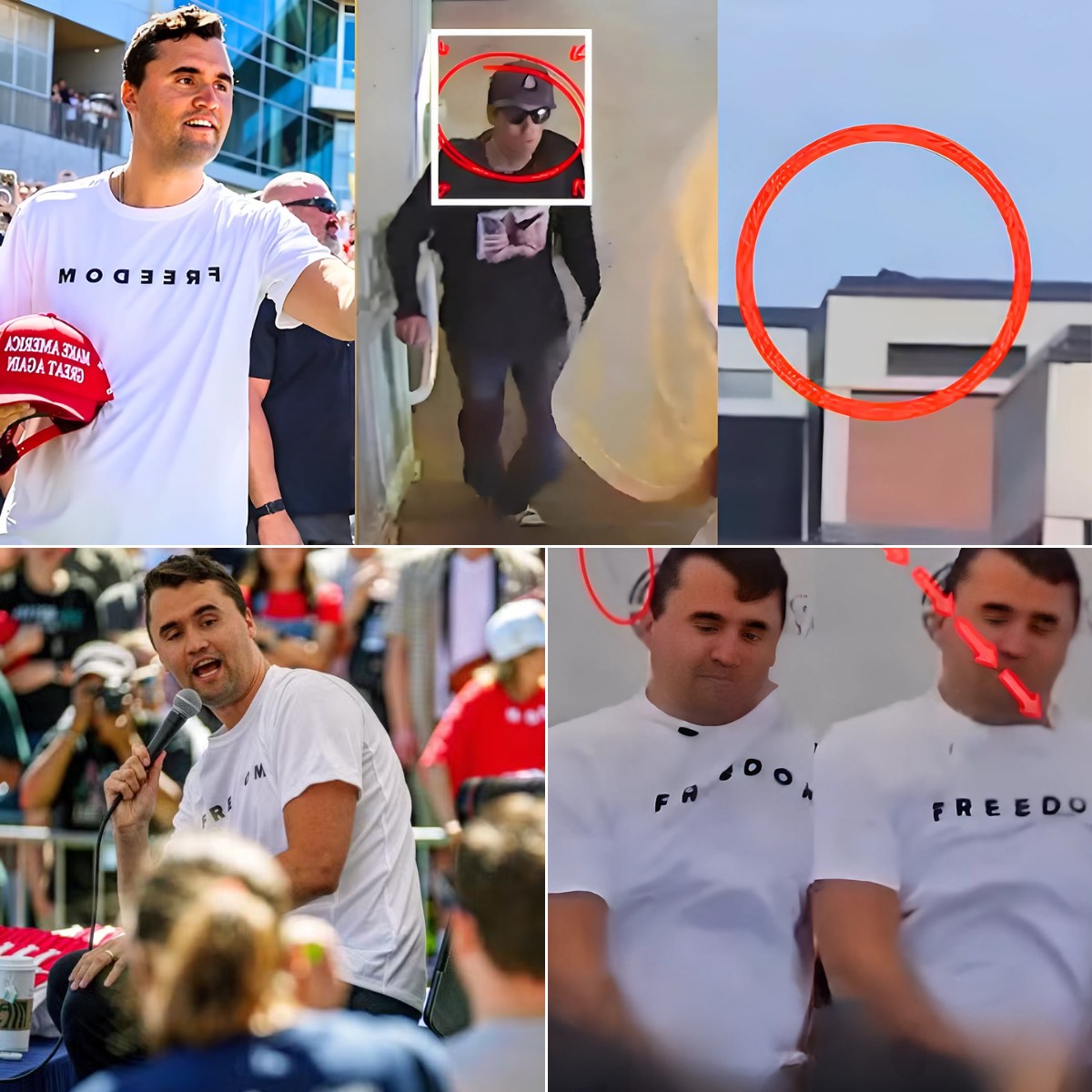
Kirk didn’t fall the way they said. That much was immediately clear to a former U.S. Marine who, after decades in combat, had seen enough chaos to spot inconsistencies that would leave most civilians bewildered.
He had survived firefights where seconds meant life or death, where every trajectory, every shadow, every movement could be a matter of survival. And yet, when he watched the video footage from the Kirk case, he found himself speechless.
Frame by frame, the video told a story that contradicted everything the official reports had claimed. Evidence ignored, anomalies in movement, and the subtle presence of a figure lurking in the bushes painted a picture far more complex than the neat narrative offered to the public.
This was not speculation; it was forensic observation informed by battlefield experience and combat medical expertise. The implications were staggering: if the truth did not align with the official account, then the story that had been sold to the public was incomplete at best, and at worst, deliberately misleading.

The Kirk case had already captured national attention.
Tyler Robinson had been identified as a suspect, positioned by authorities as the person responsible for events that shocked the community. But as the former Marine analyzed the video, it became clear that Robinson’s portrayal as the “perfect scapegoat” did not hold up under careful scrutiny. Something, or someone, else had been involved, and the real narrative remained hidden in the shadows.
The incident that would come to be known as the Kirk case unfolded over a matter of minutes but has since generated months of debate, speculation, and media coverage. According to official reports, Kirk had fallen in a particular way, under circumstances that suggested a certain sequence of events. Witnesses provided statements, investigators collected evidence, and a timeline was constructed. On paper, it appeared straightforward.
Yet inconsistencies began to emerge almost immediately. People present at the scene reported details that seemed to conflict with one another. Some noticed unusual movements in the periphery, while others were confused about the positioning of certain objects and the trajectory of the fall. Authorities claimed to have a clear understanding of what happened, but these reports often omitted what might have been inconvenient or difficult to explain.
The role of Tyler Robinson became central to the public story. Robinson was portrayed as the person whose actions had led to the incident. Media coverage highlighted his presence, suggesting culpability that aligned neatly with the official narrative.
But as the former Marine would demonstrate, the timeline, evidence, and trajectory told a far more nuanced story—one in which Robinson’s involvement, while undeniable in presence, might have been misrepresented in intent or consequence.

Combat experience offers a unique lens through which to interpret chaotic scenes. In the field, every action has a consequence. Soldiers are trained to read micro-movements, anticipate trajectories, and identify inconsistencies in what they observe.
A misstep can be fatal. Medical training in combat zones adds another layer of expertise: understanding how bodies respond to impacts, estimating the force required to produce specific injuries, and recognizing patterns that may indicate intentional action versus accidental outcomes.
The former Marine, whose identity remains confidential for professional and security reasons, approached the Kirk video with this dual expertise. His first step was to watch the footage in real time, observing general movements and overall context.
Then he began the painstaking process of frame-by-frame analysis, looking for details most viewers would never notice: the angle of a fall, the shift of weight, the position of limbs, and even subtle environmental clues.
What he found challenged every assumption made by the initial investigators. Small shadows in the background suggested the presence of a third party. The trajectory of Kirk’s fall did not align with the supposed point of impact or the alleged sequence of actions leading to the incident. Minor but critical details—like the timing of certain sounds, the way objects moved upon contact, and the position of leaves and debris—indicated that something was missing from the official narrative.
Analyzing the Kirk footage frame by frame revealed anomalies that were impossible to ignore. In one segment, Kirk’s movement appeared almost counterintuitive, suggesting that he was influenced by an external force inconsistent with the trajectory described in reports. The former Marine pointed out that the angle of impact, the speed of motion, and the resulting injuries were incompatible with the simplistic version of events offered publicly.

Further scrutiny revealed the presence of a figure partially concealed in the bushes. This person’s movements were subtle but deliberate: they remained outside of direct view for most of the footage, yet their shadow and fleeting motions indicated that they were actively observing or perhaps influencing the sequence of events. The former Marine emphasized that in combat, even minor movements can reveal intent. This figure could not be ignored—it introduced the possibility of an additional actor in the scene, someone whose involvement had been overlooked or deliberately excluded from official accounts.
The use of lighting and environmental cues in the video also played a significant role. Reflections, shadows, and ambient noise all contributed to a more complete understanding of the incident. By mapping out the trajectory of the fall and overlaying environmental observations, the former Marine created a reconstructed timeline that differed sharply from the one disseminated by authorities.
Several pieces of overlooked evidence stood out during the Marine’s review.
Kirk’s path did not match the expected curve of a standard fall. The forces acting on his body suggested interference—either through contact with an unseen object or another individual. The positioning of limbs, head angle, and force distribution all pointed to a scenario inconsistent with an accidental fall or a single-point impact.
Leaves, dust, and minor debris shifted in ways that suggested external manipulation. In multiple frames, the scattering pattern implied an intervention that had not been accounted for in the original investigation.

Perhaps the most compelling observation was the figure in the bushes. This person remained partially hidden, yet their presence and timing aligned with Kirk’s fall. While visibility was limited, the former Marine’s analysis indicated that this figure could have played an active role in the sequence of events, raising questions about motive, opportunity, and identity.
Frame-by-frame examination revealed that certain movements occurred out of sync with the official timeline. This suggested either a misinterpretation of events or an intentional misdirection in reporting. In combat terms, timing is everything. A split second can change the outcome entirely—and in this case, it raised serious doubts about the accuracy of the official story.
Tyler Robinson’s presence, previously framed as culpable, now required reexamination. The video suggested that while Robinson was present, the critical actions leading to Kirk’s fall may have originated elsewhere.
This does not absolve Robinson entirely but does complicate the narrative, showing that the story of a “perfect scapegoat” may have been engineered.
The forensic analysis conducted by the former Marine raises profound questions:
-
Who stood to benefit from a distorted narrative?
If Robinson was indeed the scapegoat, then someone else had a motive for deflecting attention. Identifying potential beneficiaries is complex but crucial to understanding the broader context. -
Why were certain details overlooked?
Minor anomalies—shadows, debris patterns, trajectory irregularities—were omitted from initial reports. Were these simply mistakes, or deliberate oversights to maintain a cohesive story? -
How does this change public perception?
When an incident is presented in a way that simplifies or omits complexity, the public’s understanding is shaped accordingly. The Marine’s analysis invites viewers to question what they were told and consider what may remain unseen. -
Ethical implications
Misrepresentation of evidence, even unintentionally, has consequences. Individuals may be wrongly accused, public trust may erode, and justice may be compromised. The Kirk case highlights how critical rigorous, independent analysis can be in ensuring fairness and accuracy.

The former Marine’s investigation is a reminder that evidence should always be examined critically. In high-profile incidents like the Kirk case, where narratives are quickly formed and disseminated, small details can hold enormous significance. Every trajectory, shadow, and movement warrants attention.
The presence of the shadowy figure, the inconsistencies in trajectory, and the overlooked environmental cues suggest that the truth is more complex than the public has been led to believe.
While official reports may provide a framework, forensic observation—especially from someone trained in combat and medical assessment—reveals a much richer, more intricate story.
Public discourse often gravitates toward simple explanations, particularly when a scapegoat is convenient. Yet complexity and ambiguity are inherent in real-world events. The Kirk case serves as a cautionary tale: the first narrative is rarely the final one, and critical thinking is essential to approaching any purported truth.
